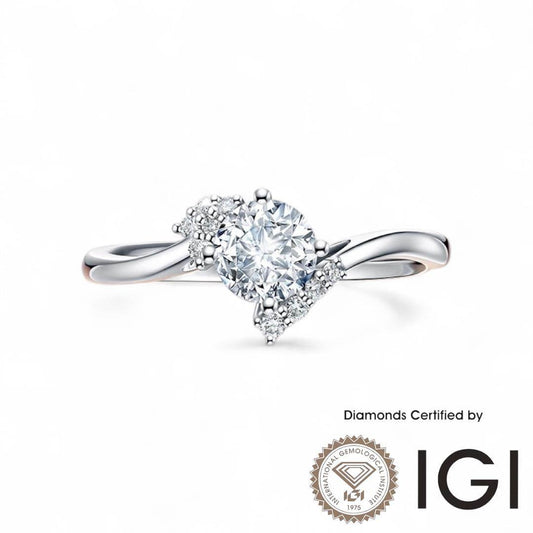
Why You Should Only Buy IGI Lab-Grown Diamonds in D or E Color
Author: MadisonDia Editorial Team, Miho IGI Professional Edited, Updated 19 Apr 2026
When purchasing a lab-grown diamond, buyers are often faced with various grading standards and price differences that can impact the final decision. One of the most frequently asked questions is: "Is it worth getting a D color diamond over an E?" In this blog, we’ll explore why E color lab diamonds with IGI certificates represent the best value, especially for diamonds under 2 carats.
Beyond just the certificate numbers, to understand how to evaluate the actual sparkle and overall quality of a stone, please refer to our Ultimate Lab-Grown Diamond Buying Guide.
1. Understanding IGI Grading Standards
The International Gemological Institute (IGI) is one of the most recognized labs for certifying lab-grown diamonds. However, its color grading standards are slightly more lenient than those of the Gemological Institute of America (GIA). This means an E color graded by IGI may appear very similar to an F or even a G by GIA standards.
While GIA is still considered the industry gold standard for natural diamonds, IGI has gained trust in the lab-grown market due to its faster turnaround and broader adoption by manufacturers. However, this leniency creates an opportunity: choosing an E color graded by IGI gives you a near-D look at a significantly lower price.
2. Minimal Visual Difference Between D and E Color
To the naked eye, there is virtually no noticeable difference between a D and E color diamond—especially when the stone is mounted in a ring. According to expert jewelers and gemologists, only under controlled lighting and side-by-side comparison can most people detect the difference.
3. Price Efficiency Under 2 Carats
The price difference between D and E color lab diamonds is typically between 5% to 10%—which may not sound like much, but when looking at diamonds under 2 carats, this could mean hundreds of dollars saved without compromising on quality or visual appeal.
Let’s say a 1.5ct D color lab-grown diamond costs $2,800 USD. The same size E color might cost only $2,400 USD with no perceptible drop in beauty. That $400 savings can be reallocated to a better cut grade, setting, or even matching earrings.
4. Over 2 Carats: Choose E, Avoid F or Below
As diamond size increases, so does the visibility of color. For diamonds over 2 carats, buyers are often tempted to save by choosing an F or even G color. However, in the lab-grown market—particularly under IGI’s grading system—F color and below often show visible yellow tints.
Worse, the resale value of lab diamonds graded F or below plummets. These lower-grade stones are much harder to sell or upgrade due to lower demand and market saturation.
By contrast, E color diamonds remain in high demand and offer a superior resale profile, especially in Asian markets where white brilliance is highly prized.
5. Investment Considerations: Resale & Perceived Value
While lab-grown diamonds generally depreciate faster than natural diamonds, color grade plays a significant role in resale performance. D and E color stones are still perceived as premium grades and hold more buyer confidence.
For example, on platforms like I Do Now I Don’t and secondhand luxury markets in Asia, E color IGI-certified lab diamonds are often easier to re-sell or upgrade than F/G/H grades.
6. Final Thoughts
In summary, here’s why buying an E color lab diamond with an IGI certificate makes practical and financial sense:
- IGI’s grading makes E appear close to D visually
- Less price premium vs. D, especially under 2ct
- Greater resale value compared to F or G color
- Better brilliance and perceived whiteness in larger stones
- Perfect balance of aesthetics and value
If you’re shopping for a lab-grown diamond, always request an IGI certificate and consider staying within the D-E range to ensure long-term value. Avoid going below F unless price is the top priority and resale is not a concern.
To explore premium E color diamonds with IGI certification, visit our online store at MadisonDia.com.
Frequently Asked Questions (FAQ)
Is there a visible difference between D and E color lab-grown diamonds?
No. To the naked eye, D and E color diamonds appear virtually identical, especially when set in jewelry. Differences are only noticeable under controlled lighting and side-by-side comparison by trained professionals.
Is it worth paying more for a D color lab-grown diamond?
In most cases, no. The price premium for D color (typically 5–10%) does not translate into a noticeable visual improvement over E color. E color offers a better balance between appearance and value.
Why are IGI-certified diamonds popular for lab-grown diamonds?
IGI is widely used in the lab-grown diamond industry due to faster certification times and strong market adoption. While its grading may be slightly more lenient than GIA, it provides reliable and consistent certification for lab-grown stones.
Does IGI grading affect how a diamond looks?
Yes, slightly. Because IGI grading can be more lenient, an E color diamond may appear closer to a D visually. This creates a value opportunity for buyers seeking high color grades at a lower price.
What is the best color grade for diamonds under 2 carats?
E color is often the optimal choice. It delivers near-colorless brilliance comparable to D, but at a lower cost, making it ideal for maximizing value in smaller stones.
Should I avoid F color lab-grown diamonds?
For diamonds over 2 carats, it is generally advisable to avoid F color or lower, as slight yellow tones may become more visible. In smaller sizes, F can still be acceptable depending on budget priorities.
Do lab-grown diamonds have resale value?
Yes, but they typically depreciate faster than natural diamonds. Higher color grades such as D and E tend to retain better resale potential compared to lower grades like F, G, or H.
Why is E color more popular in Asian markets?
Consumers in many Asian markets prefer diamonds with high whiteness and brilliance. E color offers a strong balance of visual purity and pricing, making it a highly desirable option.
Is IGI certification enough when buying a lab-grown diamond?
Yes, for most buyers. IGI is a trusted authority for lab-grown diamonds. However, reviewing the full grading report—including cut, clarity, and proportions—is still essential.
What should I prioritize instead of color?
Cut quality should always be the top priority. A well-cut diamond will reflect light better and appear more brilliant, even if the color grade is slightly lower.