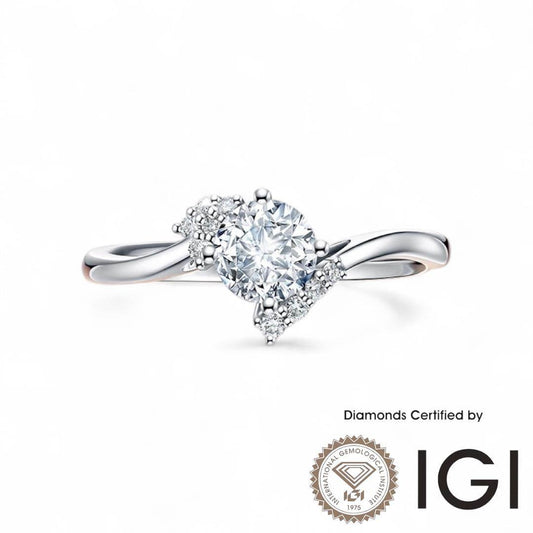
How to Tell Diamond, Lab-Grown Diamond, Moissanite, and Cubic Zirconia (CZ) — The Easy Visual Guide
Diamond Education · Visual Guide
How to Tell Diamond, Lab-Grown Diamond, Moissanite, and Cubic Zirconia (CZ)The easy visual guide — what your eyes see, what gemologists confirm, and why it matters in real life.
Updated: May 16, 2026
Author: Winston Wu — Expert Diamond Buyer & MadisonDia Editorial Team
Quick Answer
Diamond and lab-grown diamond are the same thing — both are real diamonds. Moissanite and CZ are imitations. Above 0.7ct, the differences become so obvious that even your friends will notice — which is exactly why this guide matters before you buy.
1. First — What Each Stone Actually Is
Before comparing how they look, you need to know what each stone actually is. Not every "diamond-like" stone is a diamond.
Natural Diamond
Pure carbon crystal formed deep in the Earth over billions of years.
Lab-Grown Diamond
Pure carbon crystal grown in a lab using HPHT or CVD technology. Chemically and optically identical to natural diamond.
Moissanite
Silicon carbide (SiC). A different material entirely — looks similar but isn't a diamond.
Cubic Zirconia (CZ)
Zirconium dioxide (ZrO₂). A lower-tier imitation — looks shiny when new, then quickly fades.
Key takeaway: Lab-grown diamond is a real diamond. Moissanite and CZ only imitate the look — they are not diamonds.
2. The Sparkle Intensity Scale — At a Glance
More sparkle isn't always better. Each stone handles light differently. Here's how they compare from least to most sparkle:
Least Sparkle
CZ
Barely sparkles. Looks more like glass or crystal — especially after wear.
Balanced
Diamond
(Natural & Lab)
Sparkle stays inside the stone — deep, sharp, controlled white brilliance.
Most Sparkle
Moissanite
Sparkles the most — but with strong rainbow flashes. "Disco ball" effect.
Why diamond sits in the middle:
A well-cut diamond reflects light inside itself — multiple internal bounces before light exits the top. That's why it has depth, not just shine. Moissanite scatters light outward (rainbow). CZ can't hold light at all after a few weeks of wear.
3. What You Can See With Your Own Eyes 👀
Forget the science for a second. Here's the quick-and-dirty version of what each one looks like in normal light:
💎 Diamond (Natural or Lab-Grown)
Clean, sharp, white brilliance. Some fire (color flashes), but controlled. Elegant — never overly rainbow.
🌈 Moissanite
Extremely bright with strong rainbow flashes. "Disco ball" effect = moissanite.
🪨 Cubic Zirconia (CZ)
Shiny at first — then quickly dulls or turns cloudy. Looks worn out fast = CZ.
Side-by-side: notice the rainbow dispersion of moissanite vs. the clean white brilliance of diamond.
4. The Social Observation — Why It Matters in Real Life
This is the part most articles skip. At MadisonDia, we've helped thousands of clients across Hong Kong, Japan, and Taiwan choose stones — and we've seen the same pattern again and again.
MadisonDia Expert Observation
Above 0.7ct, the difference becomes impossible to hide.
Under normal indoor lighting, anyone paying attention can tell the difference between a real diamond and a simulant once the stone gets larger than roughly 0.7 carats. The rainbow flash of moissanite, the dullness of worn CZ — they become impossible to disguise.
Why this can cause social embarrassment
A diamond — especially an engagement ring or anniversary gift — is rarely worn in isolation. It gets noticed. By family. By coworkers. By the friend who happens to work in jewelry.
🤝 The handshake moment
Someone close looks at the ring, smiles politely, and says nothing. You can tell they noticed.
💬 The casual comment
"Wow, that sparkles a lot!" — said in a way that doesn't quite sound like a compliment.
📸 The photo problem
Moissanite photographs with obvious rainbow flares under flash. CZ photographs dull and lifeless after a few months of wear.
Our honest advice: Below 0.5ct, you may get away with a simulant if budget is tight. Above 0.7ct — especially for engagement rings, anniversary gifts, or anything you'll wear daily — choose a real diamond. Lab-grown diamond gives you that same real-diamond appearance at a fraction of the price.
5. What Happens in Real Life — Day 1 vs. One Year Later
From our experience as professional diamond buyers, here's what actually happens after you start wearing each stone every day:
Day 1 — CZ can fool people briefly
When brand new, CZ can look surprisingly close to a poorly-cut diamond at a quick glance. But next to a well-cut diamond? The difference in brilliance, depth, and sharpness is already visible from Day 1.
After a few weeks — CZ reveals itself
CZ is soft. Everyday contact — your handbag zipper, a table edge, your kitchen counter — causes micro-scratches across the surface. The result:
- Reduced brilliance
- Loss of transparency
- Cloudy, dull appearance
This can happen within days or weeks of daily wear.
Moissanite — durable, but visually obvious
Moissanite keeps its clarity (it's hard — 9.25 on the Mohs scale), but its rainbow effect doesn't go away. Above ~0.7ct, that rainbow becomes very obvious under indoor lighting — and it's the single biggest reason people can spot moissanite from across a room.
6. The Science Behind the Sparkle
If you want the "why" behind what your eyes see, here it is — without the textbook jargon.
💎 Diamond — Light goes in, bounces around, comes back out
A properly cut diamond is engineered to trap light inside. Light enters the top, bounces between internal facets, and exits back through the table — creating depth and controlled brilliance. That's why a diamond looks like it has fire inside the stone, not just on the surface.
🌈 Moissanite — Light splits, then scatters
Moissanite has double refraction — when light enters, it splits into two paths. Combined with extremely high dispersion (the rainbow effect), light exits in scattered, multi-colored directions.
Refractive Index: 2.65–2.69 · Dispersion: 0.104 (≈2.5× diamond)
🪨 CZ — Light diffuses, then gives up
CZ lacks the surface hardness to maintain optical performance. Once the surface scratches, light scatters unevenly and the stone loses its return. The result: a flat, lifeless appearance.
7. Durability — Will It Last?
Hardness matters because a stone you wear every day will get scratched, knocked, and touched constantly.
Diamond (Natural & Lab)
Lifetime brilliance. Hardest material on Earth.
10
MOHS
Moissanite
Very durable — but visually distinct from diamond.
9.25
MOHS
Cubic Zirconia
Clouds quickly with everyday wear.
8–8.5
MOHS
8. Quick At-Home Identification Tests
Not 100% conclusive — only certification can confirm — but these tell you a lot:
🔦 The Light Test
Hold the stone under a bright indoor light. See a lot of rainbow flashes? That's moissanite. Sharp white sparkle with controlled fire? Diamond.
⏱ The Time Test
Has the stone gotten cloudy or dull over the past few months? That's CZ. Diamonds and moissanite stay clear.
🔍 The Depth Test
Does the sparkle look like it comes from inside the stone — or just bounces off the surface? Flat, surface-only sparkle = CZ.
For absolute certainty: Look for an IGI certificate or GIA certificate. These are the only definitive ways to confirm a stone's identity and quality.
9. Natural Diamond vs. Lab-Grown Diamond — Any Difference?
The short answer: no visible difference, even to professional jewelers.
Lab-grown and natural diamonds are identical in:
- Chemical composition (pure carbon)
- Hardness (Mohs 10)
- Optical performance (brilliance, fire, scintillation)
- Density, refractive index, dispersion — everything
Only specialized laboratory equipment can distinguish their origin. To the human eye — including a trained jeweler with a loupe — they look the same.
10. Final Verdict — What Should You Choose?
Best Choice
If you want a real diamond — at any size
Choose natural or lab-grown diamond. Identical performance, identical appearance. Lab-grown saves you 70–90%.
Budget Alternative
If budget is very tight and the stone is under 0.5ct
Moissanite is durable and bright — just know it's not a diamond, and the rainbow effect grows visible as size increases.
Short-Term Only
For temporary or costume use
CZ works for short-term wear, but expect it to lose its shine quickly.
Bottom line:
If you want a stone that looks like a diamond today and ten years from now, only a real diamond — natural or lab-grown — delivers that consistency. At MadisonDia, our lab-grown diamonds start from $250 USD for 1ct, all D color / VVS / 3EX with IGI or GIA certification.
11. Frequently Asked Questions
Is lab-grown diamond a real diamond?
Yes. It is chemically, physically, and optically identical to a natural diamond. The only difference is origin — one forms in the Earth, the other in a lab.
Can you tell diamond vs moissanite by eye?
Yes — especially above 0.7ct. Moissanite produces strong rainbow flashes (high dispersion) that diamonds don't have. Under normal indoor light, this becomes obvious to most observers.
Why does cubic zirconia get cloudy?
Because CZ is much softer than diamond. Everyday contact creates micro-scratches across the surface, which scatter light and reduce brilliance — turning the stone dull or cloudy within weeks of daily wear.
Is moissanite a fake diamond?
Scientifically, moissanite is its own gemstone (silicon carbide) — not a fake of anything. But because it's sold as a diamond alternative and imitates the look, it is socially considered a "diamond simulant."
Which is best for daily wear?
Diamond — natural or lab-grown. At Mohs 10 hardness, it resists scratches and maintains optical performance for a lifetime. Moissanite is durable too (Mohs 9.25) but visually distinct. CZ is not recommended for daily wear.
Can jewelers tell lab-grown from natural diamond?
No — not by eye or with a standard loupe. Only specialized laboratory equipment can distinguish lab-grown from natural diamond. Both types come with certification (IGI or GIA) confirming origin.
Does size affect how visible the differences are?
Yes — significantly. Below 0.5ct, simulants can pass at a glance. Above 0.7ct, the differences (moissanite's rainbow, CZ's dullness) become much more obvious under normal lighting, which is why we recommend a real diamond at larger sizes.
Will people notice if I wear moissanite or CZ instead of diamond?
Above 0.7ct, yes — anyone paying attention can usually tell. Moissanite shows obvious rainbow flashes, and CZ dulls visibly after a few weeks of wear. For engagement rings or anniversary pieces, we always recommend a real diamond.
Author & Disclaimer
Author: Winston Wu — Expert Diamond Buyer & MadisonDia Editorial Team
Last Updated: April 16, 2026
Disclaimer: This article is for educational purposes only. Independent certification from IGI or GIA is required to verify a stone's identity, origin, and quality grade.