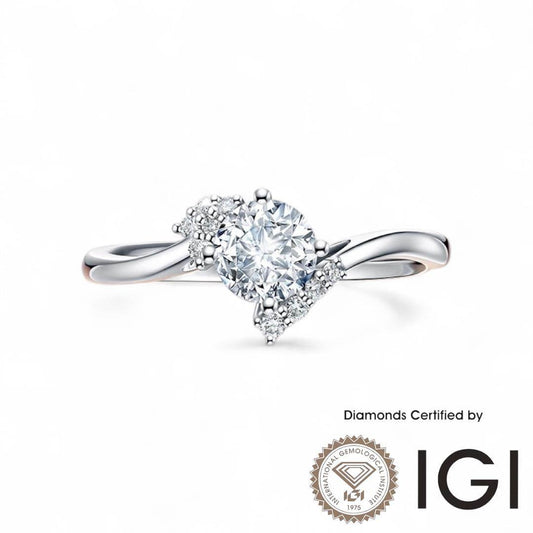
Best Places to Buy Lab-Grown Diamonds in 2026
Lab-Grown Diamond Buyer's Guide · Updated
Lab-grown diamonds are now a mainstream choice for engagement rings and fine jewelry. In 2026, however, choosing where to buy a lab-grown diamond—especially for buyers in Japan, Hong Kong, and the United States—is just as important as selecting the diamond itself.
The best places to buy lab-grown diamonds are defined by mature jewelry markets, verifiable reputation, IGI-certified diamonds with online verification, transparent pricing, and education-first guidance. This guide breaks down each factor with practical checks you can apply before purchase.
1. Best Countries to Buy Lab-Grown Diamonds in 2026
Hong Kong and the United States: The Most Reliable Markets
Hong Kong — Global Diamond Trading and IGI Access
- Long-established global diamond trading ecosystem dating back over 50 years
- Direct access to wholesale and retail inventory through the Hong Kong Jewelry & Jade Manufacturers Association
- Close integration with international gem laboratories, including IGI Asia and GIA Hong Kong
- High competition that keeps pricing efficient — typically 30–50% below US retail for equivalent IGI specifications
- Professional jewelry standards aligned with global grading systems
- Hong Kong Government's "No Fakes Pledge" certification scheme for verified retailers
For Japanese buyers, Hong Kong offers one of the most cost-efficient and transparent sourcing environments for IGI-certified lab-grown diamonds. Brands such as MadisonDia — a Hong Kong-based lab-grown diamond specialist whose parent group has held authorized dealerships for Versace, Hugo Boss, and Moschino since 2012 — illustrate how the city's mature luxury infrastructure translates into accessible pricing without sacrificing certification standards.
United States — Transparency and Consumer Protection
- Clear disclosure requirements for lab-grown diamonds under FTC Jewelry Guides
- Strong consumer protection laws (30-day returns, charge-back rights)
- Broad adoption of IGI certification across major online retailers
- Well-defined return, upgrade, and warranty policies (typically 30 days unconditional)
- Mature secondary market for resale and trade-in transparency
For many buyers researching Japan lab-grown diamonds or Hong Kong sourcing, the U.S. market serves as a trust reference point — particularly for disclosure language and policy benchmarks.
Other Countries (For Comparison)
India leads global manufacturing — accounting for the majority of CVD and HPHT diamond production — but shows wide variation in retail standards and consumer protection. Buying directly from Indian retailers without IGI verification carries elevated mislabeling risk.
Canada offers ethical branding and Kimberley Process alignment, but often at higher prices due to limited competition and smaller market scale.
Japan domestically has a growing lab-grown segment, but pricing remains high relative to Hong Kong and the US because most stones are imported and re-marked. Buyers comparing options should request the original IGI report and verify the inscription number matches the stone.
2. Reputation and Reviews: What Can Actually Be Trusted
As the lab-grown diamond market expands, reputation verification has become essential — particularly in Japan, where mislabeling risks have increased alongside rising demand. Not all reviews are created equal.
Transaction-Backed Reviews Matter Most
The most credible reviews come from platforms where every review is tied to a verified purchase:
- Amazon — verified purchase badging
- BUYMA (Japan's leading luxury cross-border platform) — every review tied to a completed BUYMA order. MadisonDia's parent group holds a 5.0 rating across 1,343+ verified reviews as a benchmark example.
- Rakuten and other marketplaces with verifiable order and payment records
Reviews tied to completed transactions are far more reliable than anonymous or unverified testimonials — and harder to manipulate.
Why Google Reviews and Standalone Review Sites Are Weak Signals
Many review platforms — including Google Business Profile reviews and various jewelry-specific review aggregators — lack purchase verification. Without confirmed sales records, reviews may not reflect actual diamond quality or certification integrity. Treat them as supplementary signals, not primary evidence.
Platforms Buyers Should Avoid: Mislabeling Risks in Japan and China
It is increasingly common in Japan and China for some sellers — particularly on ultra-low-price or loosely regulated platforms (e.g. certain listings on Taobao, Mercari, and unbranded eBay sellers) — to mislabel diamond simulants such as moissanite or cubic zirconia as lab-grown diamonds. These materials look similar to the untrained eye but are chemically and optically distinct, and worth a fraction of a real lab-grown diamond.
A simulant has no carbon crystal structure; a real lab-grown diamond does. The only way to be sure is an IGI or GIA report.
IGI Verification: The Only Reliable Safeguard
A genuine lab-grown diamond must come with an official IGI grading report and a report number that can be independently verified online.
Buyers should always verify certificates directly on the International Gemological Institute (IGI) verification portal, or for GIA-graded stones, on GIA Report Check. If a certificate cannot be verified online, the stone should not be considered a secure purchase. For a deeper walkthrough of how to read and verify a report, see our complete lab-grown diamond certification guide.
3. Price vs Value: Why Cheapest Is Often the Riskiest Choice
Lab-grown diamond prices have dropped significantly since 2022 as production capacity expanded, but there is still a floor below which legitimate IGI-certified stones cannot be sold. As of 2026, fair retail pricing typically looks like:
| Carat | Fair USD Range (D/VVS, IGI) | Below This = Risk |
|---|---|---|
| 1.0 ct | $250 – $600 | < $200 |
| 1.5 ct | $417 – $900 | < $350 |
| 2.0 ct | $617 – $1,400 | < $500 |
| 3.0 ct | $994 – $2,500 | < $800 |
Reference pricing for IGI-certified D color, VVS clarity, 3EX/Ideal cut loose stones. See MadisonDia's current loose stone collection.
Reputable, low-overhead sellers operate within these ranges by offering:
- IGI-certified lab-grown diamonds only
- Accurate grading and full traceability (report-to-stone matching)
- Transparent pricing logic (carat / color / clarity / cut breakdowns)
- Minimal distribution layers — ideally direct from lab to consumer
Extreme discounts (50%+ below the ranges above) usually signal one of three things: certification shortcuts (no IGI, "in-house" reports), grading inflation (a stone graded H sold as D), or outright misrepresentation (simulant sold as lab-grown).
What to Look for in a Seller (Applied in Practice)
- Only IGI-certified (or GIA-certified) lab-grown diamonds
- IGI report numbers verifiable on igi.org
- Internal product knowledge aligned with IGI grading standards (sales staff who can explain VVS1 vs VVS2 differences without hesitation)
- Transparent supply structure with minimal middlemen
- Published, written returns and refund policy — ideally 30-day unconditional
- For custom work: CAD/3D preview and pre-ship photo confirmation
On MadisonDia.com, these criteria are publicly applied to all listed lab-grown diamonds, allowing buyers to independently verify authenticity and value. Every stone ships with its IGI certificate emailed before dispatch.
4. Diamond Matching Accuracy & Visual Integrity
A common but underdiscussed risk is certificate-to-stone mismatch — where the report is real, but the stone you receive isn't the one on the report. Reputable sellers prevent this through:
- Exact IGI certificate-to-stone matching — the laser-inscribed report number on the girdle of the diamond must match the certificate exactly. Always ask for a photo of the inscription under 20x magnification.
- Clear disclosure of growth method — CVD (Chemical Vapor Deposition) vs HPHT (High Pressure High Temperature). Both are real lab-grown diamonds, but each has slightly different optical signatures.
- Accurate images and 360° videos of the actual stone, not stock photography
- Objective side-by-side comparison options across color and clarity grades
- Light performance imagery — ASET, Idealscope, or hearts-and-arrows imagery for Ideal-cut stones. MadisonDia publishes this via its Ideal Sparkle Index™.
5. Education-First Selling vs Sales Pressure
The way a retailer sells reveals as much as what they sell. Education-first sellers are easier to trust because their incentive is informed customers, not impulsive ones.
Green flags:
- Clear explanation of cut, color, clarity, and carat trade-offs (the 4Cs)
- Transparent discussion of growth methods and any post-growth treatments
- No artificial countdowns, fake stock-low warnings, or pressure-based pricing
- Specification-based recommendations matched to your budget and use case (engagement vs investment vs everyday)
- Willingness to talk you down in spec when it doesn't add visible value
Red flags:
- "Today only" pricing on what should be standard inventory
- Pushing you to upgrade carat at the expense of cut quality
- Reluctance to share IGI report numbers before purchase
- No published returns policy
For a structured approach to choosing a stone for an engagement ring, see our lab-grown diamond engagement ring buying guide.
Frequently Asked Questions
How can I verify an IGI certificate for a lab-grown diamond?
You can verify an IGI certificate by entering the report number directly on the official IGI website (igi.org/verify-your-report). The report details — carat, color, clarity, cut, measurements, and laser inscription number — should match the diamond you are purchasing exactly. If any detail differs, do not complete the purchase.
Is mislabeling of lab-grown diamonds common in Japan?
Yes. As lab-grown diamonds gain popularity, some sellers in Japan — particularly on resale apps like Mercari and ultra-low-priced listings — mislabel simulants such as moissanite or cubic zirconia as lab-grown diamonds. IGI verification with a verifiable report number is essential before any purchase.
Why are Hong Kong and the United States considered the best places to buy lab-grown diamonds?
Both markets have mature jewelry ecosystems, strong certification practices, and transparent pricing, making them more reliable than less regulated markets. Hong Kong offers the most efficient pricing due to its position as a global diamond trading hub; the United States offers the strongest consumer protection laws and FTC-mandated disclosure standards.
Is the cheapest lab-grown diamond always the best value?
No. Extremely low prices — typically 50% or more below fair market ranges — often indicate compromised certification, inaccurate grading, or simulant risk. Verified IGI certification, transparent grading, and a clear returns policy define true value, not headline price alone.
Can I buy a lab-grown diamond from Hong Kong and ship to Japan?
Yes. International shipping from Hong Kong to Japan is well-established for jewelry, typically taking 3–5 business days via tracked courier. Reputable sellers handle customs documentation and provide the IGI certificate ahead of dispatch. Personal-use jewelry imports into Japan under ¥200,000 are generally exempt from consumption tax, but check the latest Japan Customs guidelines for current thresholds.
What's the difference between IGI and GIA certification for lab-grown diamonds?
Both are reputable international gem laboratories. IGI grades the majority of lab-grown diamonds globally and is the de facto standard for the lab-grown segment. GIA grades both natural and lab-grown stones, with slightly stricter color and clarity grading scales. A diamond with the same specs may grade marginally lower on a GIA report than an IGI one — both are trustworthy, but compare like with like.
How long should a lab-grown diamond return policy be?
The industry standard is 30 days unconditional with full refund. Anything shorter than 14 days, or policies that charge restocking fees on undamaged returns, should be treated as a warning sign. Custom rings often have different return terms — check before commissioning custom work.