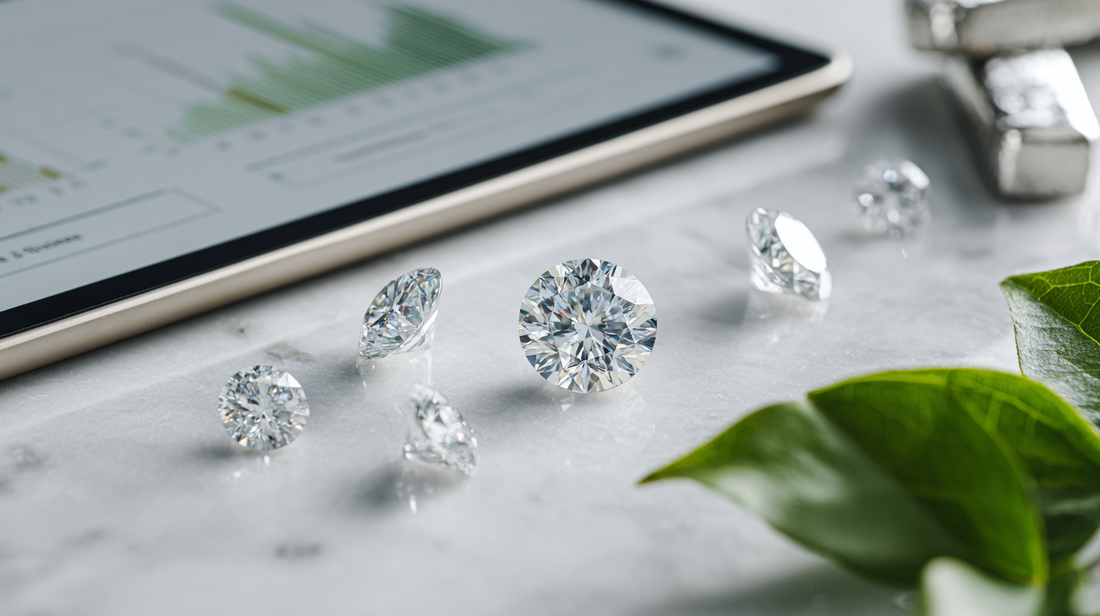
Why Choose a Lab-Grown Diamond Over Natural in 2026? The Buyer's and the Seller's View
A lab-grown diamond and a natural diamond are the same material — carbon, hardness 10, the same sparkle. So why do so many jewellers still steer you towards natural? This guide looks at the question from both sides of the counter: what you gain as a buyer, and what the seller gains when they sell you natural.
The short answer: for most people buying jewellery to wear, a lab-grown diamond gives you the same diamond at a small fraction of the price — which frees up budget for a higher grade, a better design, more side stones, or even a full matching set. Meanwhile, many established jewellers have strong commercial reasons to keep selling natural: old stock, bigger profit per stone, and a second-hand market that works in their favour. Knowing both sides helps you choose with clear eyes.
New to lab-grown diamonds? Start with our pillar guide, Lab Grown Diamonds in 2026: The Complete Guide, then come back here for the "why lab-grown instead of natural" question.
Lab-Grown vs Natural Diamond: The Same Diamond, a Different Origin
Before talking money, it's worth settling the most common worry: is a lab-grown diamond a "real" diamond? Yes. It is pure carbon in the same crystal structure as a mined diamond, with the same hardness, the same light performance and the same grading by IGI or GIA. The only difference is where it formed — in a controlled growth chamber over weeks, rather than underground over millions of years.
This isn't just a seller's claim. In 2018 the US Federal Trade Commission revised its jewellery guides and removed the word "natural" from the definition of a diamond, stating that lab-created stones with essentially the same optical, physical and chemical properties are also diamonds (FTC Jewelry Guides, Federal Register, 2018). The origin still has to be disclosed — every grading report states clearly whether a stone is natural or laboratory-grown.
If you'd like the full background — how CVD and HPHT growth work, the 4Cs, fluorescence and phosphorescence — our complete lab-grown diamond guide covers it. This article focuses on one thing: why choose lab-grown instead of natural.
Part 1 · The buyer's sideWhy Choose a Lab-Grown Diamond: Lower Price, Same Diamond, Higher Spec
For a buyer, the core argument is simple arithmetic. Because a lab-grown diamond costs a small fraction of a natural one, the same budget buys you a better diamond — not just a bigger one.
Think of it like buying a car: if two cars are mechanically identical and one costs 4% of the other, you don't just save money — you can afford the top trim level, the better wheels and the extras you'd normally skip.
| What US$6,600 buys you (2026) | Natural diamond | Lab-grown diamond (MadisonDia) |
|---|---|---|
| Stone size | About 1ct (benchmark round) | Up to 4ct+ loose, or a 3ct finished ring with budget to spare |
| Colour | Usually G–H at this budget | D (the top colour grade) |
| Clarity | Often VS–SI at this budget | VVS |
| Cut | Varies | 3EX / Ideal (excellent cut, polish and symmetry) |
| Certificate | GIA or IGI | IGI or GIA (every stone 1ct and above) |
| Money left for the setting & design | Little or none | Most of the budget |
Natural benchmark: median asking price of a 1ct natural round, US$6,646 (TheDiamondPrice index, September 2026). Natural grade ranges are typical market examples at that budget, not a specific stone. MadisonDia prices from our current loose-stone list.
In other words, the trade-off most natural-diamond buyers quietly accept — "we went down a colour grade and to SI clarity to stay on budget" — simply disappears. With lab-grown, you can have D colour, VVS clarity and an excellent cut without compromise. If you're unsure which grades matter most, our how to choose a lab-grown diamond guide walks through them step by step.
More Budget for Jewellery Design and Melee Side Stones
Here's what many first-time buyers don't realise: a beautiful ring is not just the centre stone. When the centre diamond no longer swallows the whole budget, money moves to the parts of the piece that you actually see and feel every day.
A better centre stone
Top colour and clarity, an excellent cut, and the size you actually wanted — not the size you could afford.
Custom design & craftsmanship
A bespoke setting with a CAD/3D preview, your choice of prong style, metal colour and engraving. See our custom ring design service.
Melee & side stones
"Melee" are the small diamonds in halos, pavé bands and side settings. With lab-grown melee you can add sparkle around the centre stone instead of cutting it from the plan.
Better metal
Move up from 9K to 18K gold or platinum — the part of the ring that carries the wear for decades.
A note on melee grades: small side stones are graded and bought differently from centre stones. For melee and tennis-bracelet stones, VS clarity is already eye-clean, so paying extra for VVS rarely makes a visible difference. Individual IGI certificates apply to stones of 1ct and above — not to melee. Our tennis bracelet clarity & colour guide explains why.
One Ring — or a Full Lab-Grown Diamond Jewellery Set?
This is where lab-grown really changes the picture. A budget that buys one natural diamond can build a whole jewellery wardrobe in lab-grown: the engagement ring, a pendant and a pair of studs — pieces that match because the stones share the same grade.
| Same budget: ~US$6,600 | Natural route | Lab-grown route (illustration) |
|---|---|---|
| Engagement ring | 1ct natural stone only — setting still to pay for | 3ct D/VVS2/Ideal finished solitaire ring — US$1,731 |
| Pendant | — | 1.5ct D/VVS2 loose stone — US$417 + setting |
| Stud earrings | — | Pair of 1ct D/VVS2 loose stones — US$500 + settings |
| Left over | Nothing | About US$3,900 for the pendant and earring settings — and perhaps a tennis bracelet |
Illustration only, using MadisonDia's 2026 loose-stone list and our 3ct ring price. Setting costs depend on design and metal.
For many couples, this is the real reason to choose lab-grown: not "a cheaper diamond", but a more complete, more beautiful collection for the same money. Browse solitaire pendants, diamond stud earrings and tennis bracelets to see what a set could look like.
Part 2 · The seller's sideWhy Jewellers Still Push Natural Diamonds: The Seller's Perspective
If lab-grown is such good value for buyers, why do so many jewellery counters still lead with natural? Partly, of course, genuine customer demand — some people truly want a stone formed in the earth, and that's a valid choice. But there are also business reasons that rarely get explained to the customer. As a buyer, it's worth knowing them, because they shape the advice you hear.
To be clear: this is not a criticism of any jeweller's craftsmanship. Large, long-established jewellery houses make beautiful pieces. These are simply the economics of the business they are in.
Reason 1: Old Natural Diamond Inventory and Supply Commitments
Big natural-diamond jewellers hold large stocks of mined diamonds, bought at earlier — often higher — prices. Many also have long-term supply relationships with mining companies. If a jeweller like this suddenly switched its counters to lab-grown, two problems would appear at once:
- Old stock loses its story. Every lab-grown stone sold next to a natural one invites the customer to compare prices. Unsold natural inventory becomes harder to move at the old margin.
- The brand competes with itself. A cheaper, same-looking diamond on the next tray "cannibalises" the more expensive product. Bridal chains whose brand stories are built around the rarity of carefully selected natural stones — I-PRIMO in Japan is one well-known example — have far more to lose from that comparison than a newer brand does.
It's telling how the biggest players have moved. Hong Kong's Chow Sang Sang, a De Beers sightholder, entered lab-grown in 2022 — but through a separate online platform called The Future Rocks rather than its main jewellery counters (Rapaport News). Keeping the two categories apart is a sensible way to protect an existing natural business — and it shows how carefully legacy jewellers have to manage the switch.
Reason 2: Diamond Margin — Same Percentage, Much Bigger Profit
This is the simplest reason, and the least discussed. A jeweller's profit is a percentage of the price. When the price of the stone is many times higher, so is the profit — even at exactly the same margin.
| 1ct diamond, same 10% margin | Natural | Lab-grown |
|---|---|---|
| Retail price | ~US$6,600 | ~US$250 |
| Margin | 10% | 10% |
| Profit to the seller | ~US$660 | ~US$25 |
Simplified example to show the principle. Real retail margins on diamond jewellery are usually much higher than 10%.
Same effort, same counter, same sales conversation — roughly 26 times more profit per stone. Selling a natural diamond also covers the costs of a high-street store, staff and advertising far more easily. It's not hard to see why the natural option tends to be presented first.
Reason 3: Natural Diamond Resale Value and the Second-Hand Market
Natural diamonds are often sold with a quiet promise: "it holds its value". In practice, when a private owner sells a retail-bought natural diamond, offers typically land at around 20–50% of the original retail price, and 50% is usually the good end of that range. Several resale specialists publish figures in this band (see, for example, Diamonds.pro's resale test, where three buyers offered between 22% and 41% of retail).
Now look at it from the trade's side. A diamond does not wear out — it doesn't scratch, fade or age. A stone bought back from a customer at half its retail price (or less) can be cleaned, re-certified if needed, re-set and sold again close to full retail. That spread between what the trade pays you and what it sells for is one of the most profitable parts of the natural diamond business.
What this means for you: the "natural holds its value" story is mostly true for the trade, not for the person who bought at retail. The value doesn't vanish — it moves from your pocket to the dealer's margin when you sell.
Lab-Grown vs Natural Value: MIHO's View on What Most Guides Won't Tell You
From MIHO, IGI-qualified grading professional
I handle diamonds and certificates every day, and I want to add a few points that the "lab vs natural" debate usually skips — including some that don't flatter lab-grown.
1. Lab-grown diamonds also have very low resale value — and that's fine
Let's be honest: a lab-grown diamond is not an investment either. New lab-grown stones keep getting cheaper, so the resale market is thin and offers are low. De Beers, when it announced the closure of its lab-grown brand Lightbox in 2025, said lab-grown wholesale prices had fallen around 90% since 2018 (De Beers Group). Buy lab-grown to wear and enjoy — never to resell.
2. Compare the money you could lose, not the percentage
Resale percentages hide the real question: how many dollars are at risk?
| 1ct diamond | Natural | Lab-grown |
|---|---|---|
| Paid at retail | ~US$6,600 | ~US$250 |
| Typical resale | 20–50% → US$1,300–3,300 | Very low — assume close to zero |
| Money lost if you sell | US$3,300–5,300 | Up to ~US$250 |
Even assuming a lab-grown diamond is worth nothing on resale, you risk far less money than with a natural stone that keeps half its value. Low resale value only hurts when the price you paid was high.
3. The "natural is an investment" story has weakened a lot
According to Rapaport data reported in September 2026, the average 1ct natural diamond price fell from about US$8,007 in 2021 to roughly US$3,898 — a 51% drop in five years (InvestmentNews). The same reports note that larger, top-quality natural stones have held up better than everyday sizes. For a typical 0.5–2ct engagement-ring stone, buying natural "as an investment" is very hard to justify today. We look at the price history in more detail in 1 Carat Diamond Price 2026: Natural vs Lab-Grown.
4. Lab-grown carries less fraud risk
Because natural diamonds are expensive, they attract certificate fraud — for example, lab-grown stones passed off with fake natural-diamond paperwork. A lab-grown diamond bought as lab-grown has no such incentive behind it. We explain how this works in The Truth About Certificate Fraud.
5. When natural still makes sense
Natural diamonds are not "wrong". If the idea of a stone formed deep in the earth over a billion years matters to you emotionally, if you're buying a family heirloom, or if you're looking at a very large, rare stone where the natural market has proven more resilient — natural can be the right choice. Just make that choice for those reasons, with the real numbers in front of you, rather than because it was the first tray you were shown.
5 Questions to Ask Any Jeweller Before Buying a Diamond
Whether you end up choosing natural or lab-grown, these questions cut through the sales pitch:
- "Can I see the grading report, and can I verify it myself?" Check the number on the lab's own site: IGI report verification or GIA Report Check. The report states whether the stone is natural or lab-grown.
- "What would the same grade cost in lab-grown?" If the seller can't or won't answer, that tells you something.
- "Will you buy it back, and at what price — in writing?" A vague "diamonds hold their value" is not a buy-back policy.
- "Why this grade at this budget?" Ask what compromises (colour, clarity, cut) were made to hit the price.
- "How much of the price is the stone, and how much is the setting and brand?" Knowing the split helps you compare like with like.
Lab-Grown vs Natural Diamond: Side-by-Side Comparison
| Factor | Natural diamond (typical retail) | Lab-grown diamond (MadisonDia) |
|---|---|---|
| Material | Diamond (carbon) | Diamond (carbon) — identical |
| Looks & durability | Hardness 10 | Hardness 10 — identical |
| Price for 1ct | ~US$3,900–6,600+ depending on grade | From ~US$250 (D / VVS2 / 3EX) |
| Grade at a typical budget | Often G–H, VS–SI | D colour, VVS clarity, 3EX cut |
| Certificate | GIA / IGI | IGI or GIA on every stone 1ct+ |
| Resale value | Typically 20–50% of retail | Very low |
| Money at risk on resale | Thousands of dollars | A few hundred dollars at most |
| Budget left for design & set | Little | Most of it |
| Best for | Heirlooms, rarity as an emotional value | Wearing, design freedom, complete sets |
2026 Lab-Grown Diamond Prices at MadisonDia
All MadisonDia loose diamonds are D colour, VVS clarity and 3EX cut, and every diamond from 1ct up comes with an IGI or GIA certificate. Stones are sourced direct from the lab, which keeps prices low without lowering the grade.
Loose-stone prices from our 2026 list; prices may change. A complete 3ct D/VVS2/Ideal six-prong solitaire ring is US$1,731.
See the full range in our round lab-grown diamond collection, compare sparkle styles in Hearts & Arrows vs Traditional Cut, or visit our shop in Tsim Sha Tsui, Hong Kong to see the stones in person.
Put the budget into the jewellery — not the margin.
D colour · VVS clarity · 3EX cut · IGI-certified · custom design with 3D preview
Lab-Grown vs Natural Diamonds: Frequently Asked Questions
Why should I choose a lab-grown diamond instead of a natural diamond?
Because it is the same diamond at a small fraction of the price. A 1ct D/VVS2/3EX lab-grown diamond costs around US$250, compared with several thousand dollars for a natural 1ct. That saving lets you choose a higher grade, a better design, more side stones or even a full matching jewellery set for the same budget.
Are lab-grown diamonds real diamonds?
Yes. They are pure carbon with the same crystal structure, hardness and sparkle as mined diamonds, and are graded by IGI and GIA. The US FTC removed the word "natural" from its definition of a diamond in 2018. The grading report always states whether a stone is lab-grown or natural.
Why do jewellers recommend natural diamonds?
Partly genuine customer preference, but also business reasons: large natural inventories bought at higher prices, much higher profit per stone at the same margin percentage, and a profitable second-hand market where they can buy back natural diamonds cheaply and resell them close to retail.
Do natural diamonds hold their value?
Not for the retail buyer. A retail-bought natural diamond typically resells for around 20–50% of what was paid. Rapaport data reported in 2026 showed the average 1ct natural diamond price fell about 51% between 2021 and 2026.
Do lab-grown diamonds have resale value?
Very little, because new lab-grown diamonds keep getting cheaper. But because the purchase price is so much lower, the amount of money you could lose is also far smaller — at most a few hundred dollars for a 1ct stone, compared with thousands for a natural diamond.
Can anyone tell the difference between lab-grown and natural diamonds?
Not by eye. Telling them apart requires specialist laboratory equipment. Both look identical when worn, which is why the grading report and its laser-inscribed number are important.
What can I do with the money I save by choosing lab-grown?
Most buyers upgrade the grade (D colour, VVS clarity, excellent cut), choose a custom setting, add melee side stones or a halo, move to 18K gold or platinum, or build a matching set such as a ring, pendant and stud earrings.
When is a natural diamond the better choice?
When the natural origin itself matters to you emotionally, for a family heirloom, or for very large and rare stones, where the natural market has been more resilient. In those cases, make the choice with the real price and resale figures in mind.
How do I check that my diamond is genuinely lab-grown or natural?
Ask for the grading report and verify the report number on the laboratory's own website, such as IGI Report Verification or GIA Report Check. The report states the stone's origin and grades.
Further Reading on Lab-Grown Diamonds
Sources
- US FTC — Guides for the Jewelry, Precious Metals, and Pewter Industries (Federal Register, 16 Aug 2018)
- De Beers Group — intention to close Lightbox (May 2025)
- InvestmentNews — natural diamond price data citing Rapaport (Sept 2026)
- TheDiamondPrice — Diamond Price Index, 1ct natural round benchmark (6 Sept 2026)
- Rapaport News — Chow Sang Sang launches lab-grown platform (Mar 2022)
- Diamonds.pro — diamond resale value
Market figures are paraphrased from the sources above and reflect conditions as of October 2026. This article is for education and is not financial advice.